The largest tropical rainforest on Earth, spanning nine countries, drained by the Amazon River and its tributaries.
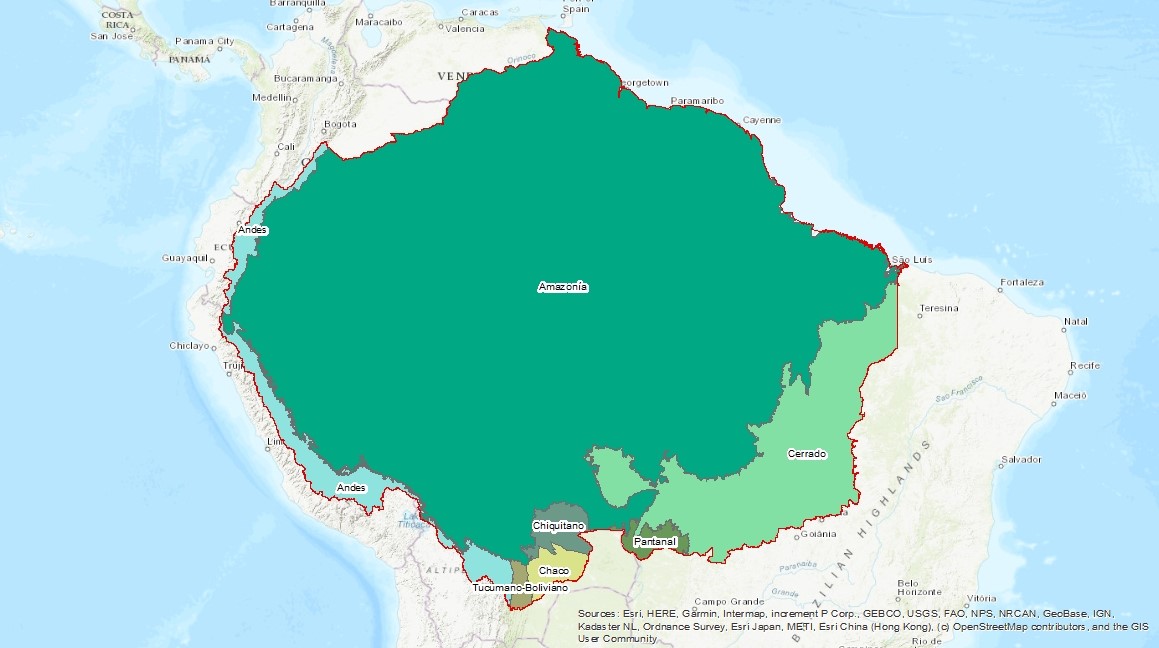
Brazil: Contains approximately 60% of the entire Amazon region, making it the largest holder of the biome.
Peru: Holds about 11% to 13% of the rainforest, stretching westward toward the Andes.
Colombia: Accounts for roughly 6% to 8% of the Amazon territory.
Bolivia: Contains around 6% to 8% of the southern portion of the basin.
Venezuela: Accounts for about 6% of the northern Amazon ecosystem.
Guyana: Holds roughly 2% to 3% of the forested region.
Ecuador: Contains about 1% to 2% of the rainforest near the Andean foothills.
Suriname: Accounts for roughly 2% of the eastern portion of the biome.
French Guiana: A French overseas territory that holds about 1% of the northeastern area.
Seasonal Comparison
| Region / Countries | Peak Rainy (High-Water) Months | Drier (Low-Water) Months |
|---|---|---|
| Southern Amazon (Brazil, Peru, Bolivia) | December to May | June to November |
| Northern Amazon (Venezuela, Colombia) | May to October | December to April |
| The Guianas (Guyana, Suriname, French Guiana) | May–Aug & Dec–Jan | Aug–Nov & Feb–Apr |
Biomes / ecosystem types within the Amazon
| Biomes | ecosystem types within the Amazon |
|---|---|
| Terra firme | upland forest, never floods |
| Várzea | floodplain, seasonal high water |
| Igapó | permanently flooded forest |
| Campina / campinarana | white-sand forests |
| Cerrado transition | savanna edge in Brazil/Bolivia |
What the directory covers
This directory brings together nature-focused and community-led places to stay, including lodges, ecolodges, eco-resorts, camps, glamping sites, homestays, guesthouses, farm stays, community tourism initiatives, Indigenous-owned accommodations, conservation projects, and other responsible travel experiences.
It is designed to help you discover places—not to compare or book them. The directory does not include prices, availability, booking services, or guest reviews.
Browse by country, explore by experience—such as wildlife, nature, culture, adventure, or conservation—or filter by category to find the type of property that interests you.
Practical orientation for travelers
Plan your journey with a quick overview of how to reach each destination, whether by air, river, road, or a combination of routes. Listings may also note commonly spoken languages and include brief health guidance, such as yellow fever requirements and malaria-risk areas.
| Country / territory | Official language(s) | Major Indigenous language(s) |
|---|---|---|
| Brazil | Portuguese | Tikuna (Ticuna) |
| Peru | Spanish; Quechua, Aymara, and other Indigenous languages where predominant | Quechua |
| Colombia | Spanish; Indigenous languages are official in their territories | Wayuunaiki (Wayuu) |
| Bolivia | Spanish and 36 Indigenous languages, including Quechua, Aymara, and Guaraní | Quechua, Aymara, and Guaraní |
| Venezuela | Spanish; Indigenous languages are official for Indigenous peoples | Wayuunaiki (Wayuu) |
| Guyana | English | Macushi (Makushi) |
| Ecuador | Spanish; Kichwa and Shuar are recognized for intercultural relations | Kichwa (Quechua) |
| Suriname | Dutch | Arawak (Lokono) |
| French Guiana | French | Kali’na and Wayana |