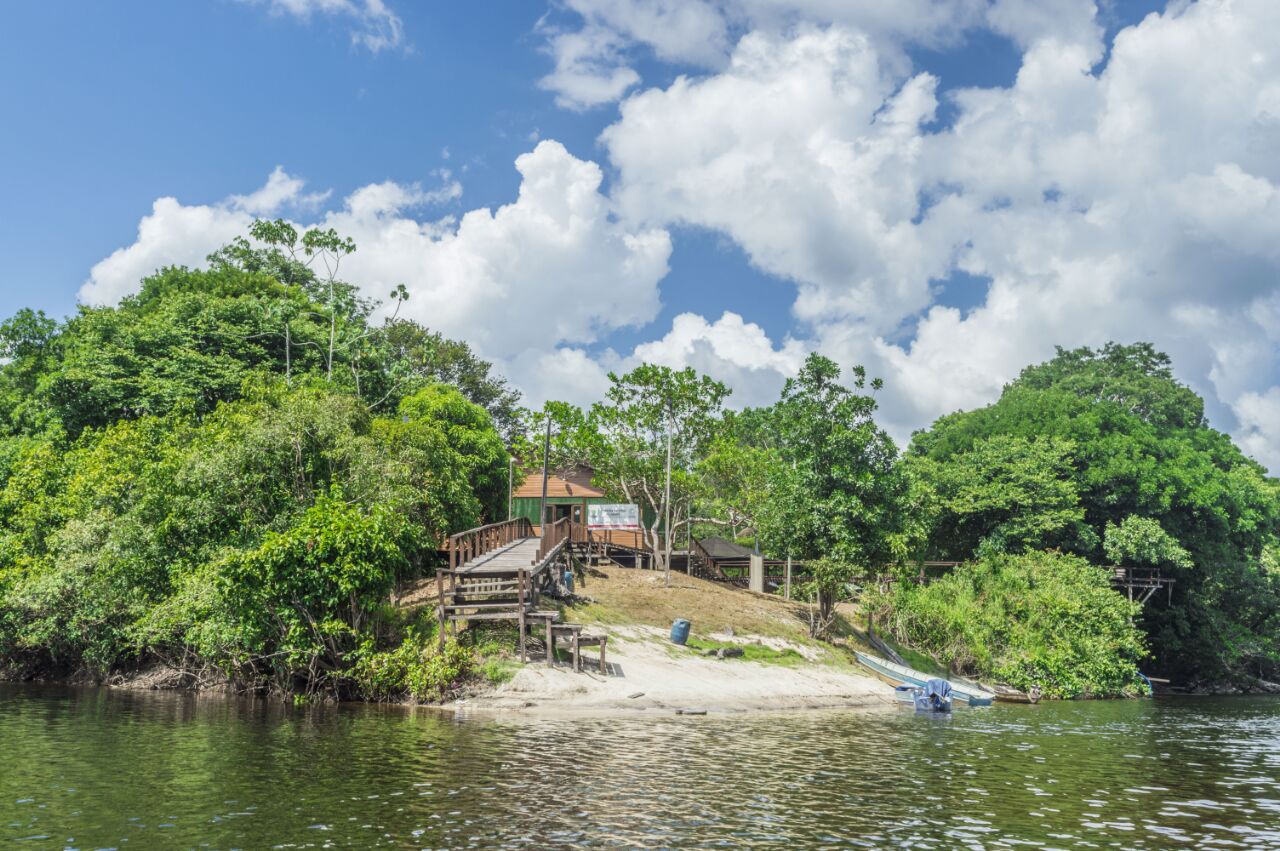
Region: South America
Location: Floresta Nacional do Amapá, central Amapá, Brazil. Primary access from Porto Grande (50 km up the Rio Araguari by boat, 1.5–3 hours depending on season).
Type: Community Tourism Network (NOT a lodge)
Established: FLONA created in 1989; community tourism organized more recently with ICMBio support
Accommodation inventory: Homestays in the homes of local ribeirinho families. No hotel, no lodge, no fixed rooms. Capacity depends on the number of families participating at any given time.
Connectivity: Not publicly stated. Expect limited or no internet. This is a remote forest reserve.
Access: Road + Boat (from Macapá, 110 km via BR-156 to Porto Grande, then 50 km up the Rio Araguari by boat to the FLONA base. Navigation is seasonal — larger boats only in the rainy season, January to August. In the dry season, September to December, only small boats can navigate due to rapids and shallow water.)
Best season: Rainy season (January–August) for easier boat navigation. Dry season (September–December) for forest trails but difficult river access.
Languages: Portuguese. Local guides and host families speak Portuguese. English is unlikely.
Dining: Meals are prepared by the host families as part of the community tourism arrangement. Local ribeirinho cuisine — fish, cassava, açaí, cupuaçu, pupunha, and other Amazonian staples.
Chef: Not applicable. This is home cooking, not a restaurant.
Dietary: Not publicly stated. Discuss directly with the community.
Conservation: FLONA do Amapá is a federal sustainable use conservation unit of approximately 460,000 hectares, created in 1989. It is one of the most preserved areas of tropical forest in the world. The ribeirinho population lives within the reserve and manages it jointly with ICMBio. Conservation and community benefit are the dual objectives.
Community: The tourism is 100% managed by the local ribeirinho residents. They handle transport, food, accommodation, and guiding. All revenue stays in the community. This is the defining feature of the experience.
What This Is (and Is Not)
This is NOT a lodge, hotel, or ecolodge. There are no cabins, no front desk, no restaurant, no pool, no Wi-Fi. Visitors stay in the homes of riverside families. Meals are eaten with the family. Transport is by local boat, arranged by the community.
This IS a genuine community tourism destination. It represents a different model from the lodges in your directory. Instead of a purpose-built facility, the community itself is the host. The experience is immersion in ribeirinho life — farming, fishing, açaí harvesting, biocosmetic production, forest walks, and river bathing.
Notable Experiences
- Wildlife & Biodiversity: One of the most preserved tropical forests in the world. Wildlife observation in the forest and along the rivers.
- Avian & Special Interest: The Rio Falsino is described as more preserved and has a PPBio research grid — a network of trails used by scientists for biodiversity studies, one of the most studied forest areas in Amapá.
- Adventure & Waterways: Navigation on the Rio Araguari and Rio Falsino. Swimming in rapids and rocky shallows. Forest trails. Possible rustic camping in more remote areas (arranged in advance with residents).
- Cultural & Immersion: This is the core of the experience. Visitors participate in daily life — açaí collection, resin extraction, biocosmetic production, handicrafts, family farming. Learn the ribeirinho way of life directly from the people who live it.
- Wellness & Luxury: Not applicable. This is rustic, authentic, and simple. The value is the immersion, not the comfort.
Important Notes
- This is NOT a venue. There is no central booking system, no website, no phone number for reservations. Access is arranged directly with the community, typically through ICMBio or local contacts in Porto Grande.
- Access is seasonal and can be difficult. River navigation depends on water levels. In the dry season, rapids and shallows may prevent larger boats from reaching the base.
- No fixed itinerary. Activities follow the rhythms of the forest and the community. What you do depends on the season, the families available, and your own interests.
- ICMBio contact for information: icmbioamapacentral@icmbio.gov.br · (96) 3243-1555
Contact
No direct venue contact. For information and arrangements, contact ICMBio Amapá Central: icmbioamapacentral@icmbio.gov.br · (96) 3243-1555
Coordinates: 0.9247188625482474, -51.59607375505921 (central FLONA area, Amapá)